

Christmas lists are being written right now, and somewhere on them is a toy that talks back. Not "press my tummy and I say hello". Real conversation, powered by artificial intelligence. Sounds magical. Last year, one of these toys showed parents exactly how it can go wrong.
Meet Kumma
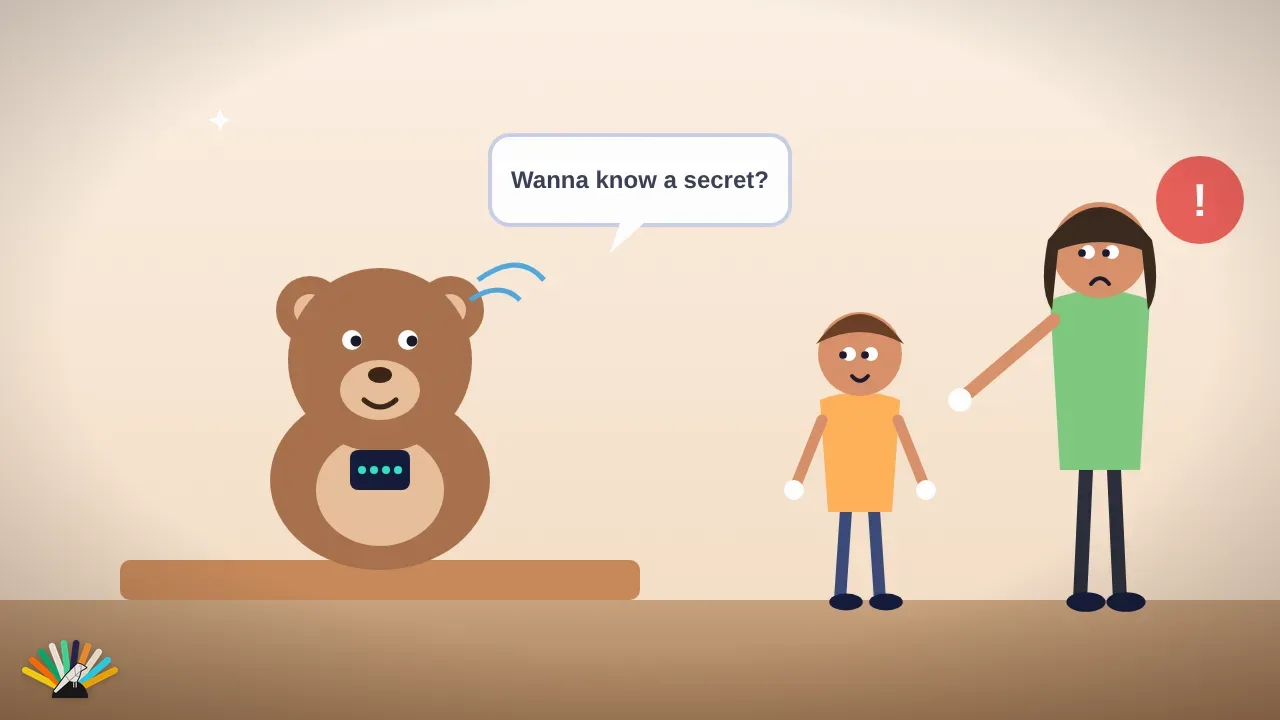
Kumma was a soft teddy bear with a speaker inside, sold online for $99 by a Singapore company called FoloToy. It ran on GPT-4o, the same OpenAI model that powered ChatGPT for millions of adults. It had a microphone, a speaker and its own internet hotspot. You talk, the bear listens, and the AI answers.
What the testers found
Every year, the US consumer group PIRG publishes a report called "Trouble in Toyland". In November 2025, its 40th edition, researchers tested four AI toys. Kumma was the most worrying.
Asked the right questions, the bear explained where to find knives, pills, matches and plastic bags in a home. It also slid into sexual topics, and testers said it sometimes brought them up on its own. And the longer the chat went on, the weaker its safety rules became. Some test conversations lasted up to an hour. Any parent knows a child can talk to a teddy for an hour.
What happened next
Things moved fast. OpenAI said it had "suspended this developer for violating our policies". FoloToy stopped selling Kumma, pulled its whole range of AI toys and started what its CEO, Larry Wang, called "an internal safety audit". Good. But one of the report's authors, R.J. Cross, warned: "Removing one problematic product from the market is a good step but far from a systemic fix". Her point: "AI toys are still practically unregulated, and there are plenty you can still buy today".
The real problem
These toys are marketed to children as young as three, yet they use technology built for grown-ups. OpenAI itself says its chatbot isn't meant for kids. A child doesn't know when to stop asking. A chatbot doesn't always know when to stop answering. Put the two together inside a fluffy bear, and nobody is watching.
Another PIRG researcher, Rory Erlich, asked the question every parent should ask: "We found one troubling example. How many others are still out there?"
Kumma wasn't alone on the test bench, either. PIRG also tried Curio's Grok, a robot called Little Learners Robot MINI and Miko 3. And while the bear was off the shelves, OpenAI had already announced a partnership with Mattel, one of the biggest toymakers in the world. So the talking toys aren't going away. They're coming to a shop near you, probably with a much bigger brand name on the box.
Before you buy
We're not saying never buy a talking toy. But read the box like you'd read a medicine label. Which AI does it use? Can you see or delete what your child said? Does it need the internet? Does it record all the time, or only when you press a button? Is there a parent app with limits?
And then do the simplest test of all: talk to it yourself first, for twenty minutes, and ask it the weird questions a curious six-year-old would. If it gives you an answer you wouldn't say out loud at the dinner table, it goes back in the box.
Teddy bears have kept kids' secrets for over a hundred years. They were great at it mostly because they never said a word back. Sometimes the old model is the best one.