

A Big Mac is one of the most boring objects on Earth, and that's exactly why it's useful. Same recipe, same box, same sad pickle, all over the world. If the burger is identical, any difference in price tells you something about money, wages and life in that place.
Economists noticed this decades ago. The Economist magazine has run a "Big Mac Index" for years, and the idea even has a nickname: "burgernomics".
The price list
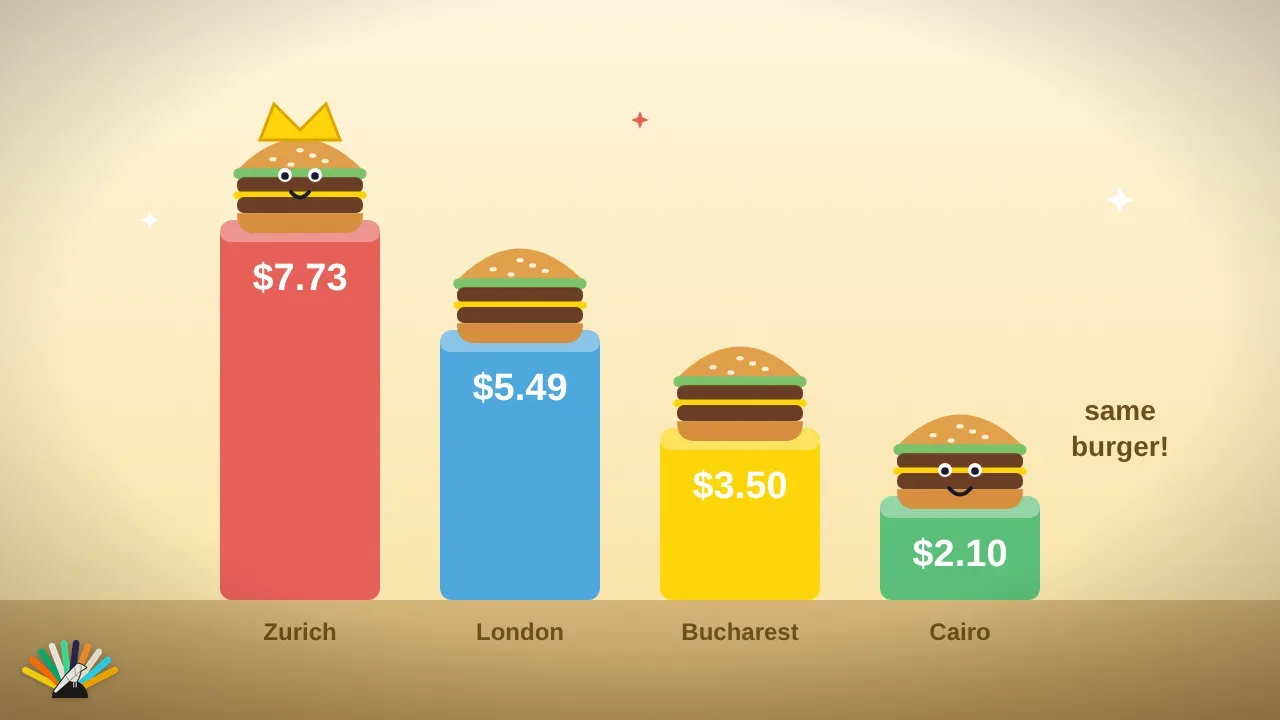
A site that tracks prices in 150 cities took a snapshot in February 2026. Here's what one Big Mac cost, in US dollars:
Zurich and Geneva: $7.73. The most expensive on the list. New York, Chicago, Los Angeles and most big US cities: $5.69. London: $5.49. Amsterdam: $5.45. Paris: $5.29. Berlin: $5.19. Rome and Milan: $5.07.
Then it drops. Bucharest: $3.50. Tokyo: $3.15. Mumbai and New Delhi: $2.49. Istanbul: $2.30. Moscow: $2.20. Cairo: $2.10. The cheapest on the list was Maputo, in Mozambique, at an estimated $2.02. The middle of all 150 cities was $4.09.
So a Swiss Big Mac costs more than three and a half times an Egyptian one. Same burger. Same pickle.
Switzerland wins again
This isn't a one-off. In the Economist's own index from July 2025, a Big Mac in Switzerland cost 7.20 Swiss francs, about $9 that day, against $6.01 in the US. Switzerland came out top in the 2026 edition too, with Israel in second place. If you ever eat a burger in Zurich, eat it slowly.
Why so pricey? Swiss wages are high, and so is everything else: rent for the restaurant, the cashier's pay, the lettuce. The Swiss franc is also a very strong currency, so when you turn francs into dollars, the number jumps.
And why is Bucharest so cheap?
For a Romanian, $3.50 feels normal. For a tourist from London, it feels like a bargain. Wages and rents in Romania are lower than in Western Europe, so the restaurant spends less, and the menu price follows. In Japan, the cheap price mostly comes from a weak yen: the Economist's 2025 index found its currency about 46% "undervalued" by the burger test. Egypt and Indonesia came out the most undervalued of all.
Here's the simple version. If a Big Mac in your country costs much more than in the US, your money is "strong" by burger logic. If it costs much less, your money is "weak". It's like checking exchange rates with your stomach.
Don't take it too seriously
Even the people who invented it say it's a game. The Economist itself admits "burgernomics was never intended as a precise gauge". And our sources don't measure the same way: one checks city menus, the other national averages, which is why the US shows $5.69 in one and $6.01 in the other. Prices also change with every exchange rate wobble.
But it's a fun, honest little mirror. A burger costs what the people around it earn, pay in rent and spend on lettuce.
What it means for you
Next time you travel, check the Big Mac before you check the hotel. If it's more expensive than at home, so is the taxi, the coffee and the museum. If it's cheaper, enjoy it, and leave a good tip. The person flipping your burger is the reason it's cheap.