

Every cat owner knows the scene. You buy an expensive toy. The cat ignores it and climbs into the box it came in. It turns out scientists have been quietly trying to understand cats like this, and they used magic tricks to do it.
The trick
Researchers at the University of Sussex in England wanted to test something called object permanence. It's a big name for a simple idea: knowing that a thing still exists when you can't see it. Babies learn it. Dogs and apes are good at it. If you hide a ball behind your back, a dog knows the ball didn't vanish.
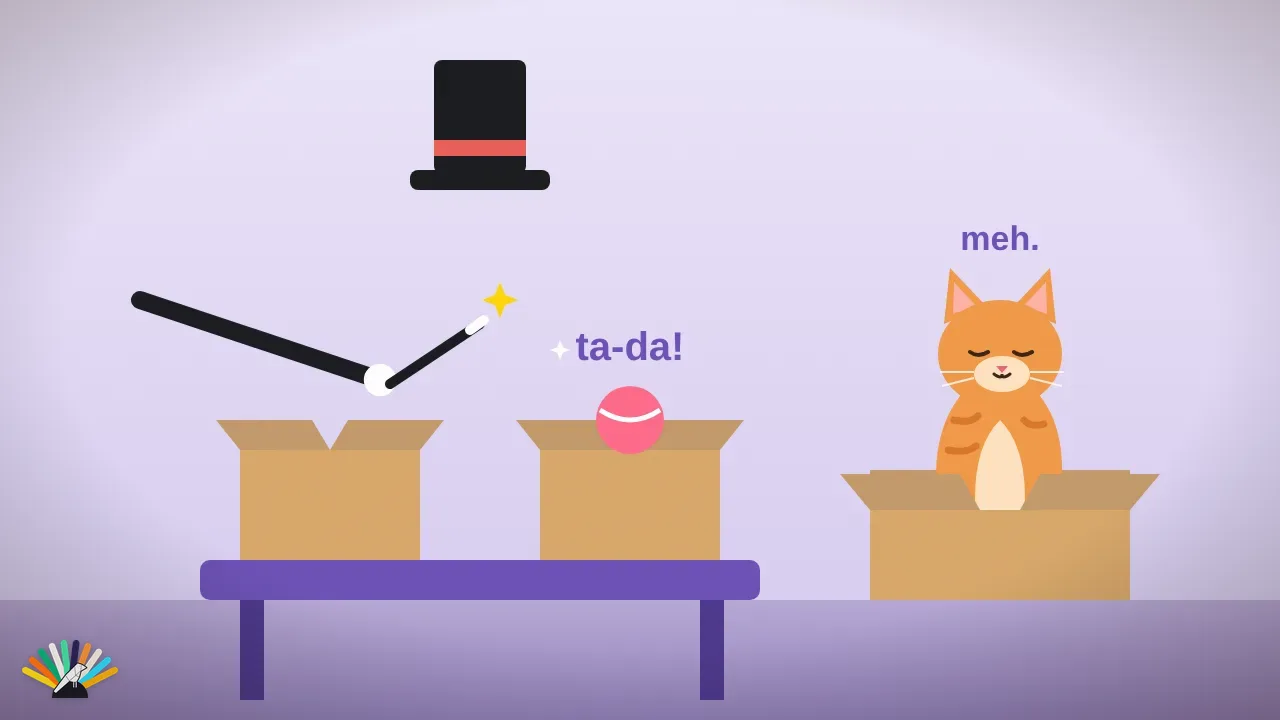
So the team showed each cat a toy and put it, in plain sight, into one of two boxes. Then the boxes were covered, moved around, and sometimes swapped, a bit like the cup-and-ball trick on a street corner. At the end, the toy appeared either where the cat expected it, or somewhere it shouldn't be. Then the scientists timed how long the cat stared.
Sometimes the trick was done by the cat's owner. Sometimes by a stranger. The study was published in the journal PLOS ONE in July 2025.
What the cats did
Here's the first surprise. Nearly half the cats didn't even try to look for the toy when it was hidden in a box. Not because they couldn't. They just didn't feel like it. The researchers think the problem was motivation, not brains. Anyone who has tried to get a cat to do anything will nod here.
The cats did notice when something odd happened. They looked longer at the toy when a normal, expected event came first and the surprise came after. As lead researcher Jemma Forman put it, "cats were able to discriminate between expected and unexpected events".
But the real finding was this: cats were more likely to play with the toy when it turned up right where it was first hidden. The surprise didn't excite them. The predictable version did. So much for the curious cat.
Strangers and certain kinds of cats
With a stranger doing the trick, the cats played more with the toy but stayed away from the boxes. Co-author Jordan Rowe said cats "can exhibit avoidant or hesitant behaviour around unfamiliar humans", yet still showed a general interest in the task.
Some cats were keener than others. Female cats, indoor-only cats, mixed breeds and cats living with other cats were more likely to be interested in the toy. One guess from the coverage: indoor cats are simply more used to toys as their entertainment. The researchers say no solid conclusions yet, and more study is needed.
Why scientists care
Cats are famously hard to study. Forman said cats have "a reputation for being highly curious animals yet are seemingly unmotivated in research studies". Her team says the results support more "cat-friendly" ways of doing research. In plain words: if you want to know what a cat thinks, you have to work on the cat's terms. Every owner already knew this. Now it has a citation.
What it means for you
The study doesn't hand out tips, so take this as our reading, not theirs. If your cat ignores a new gadget, it may not be bored or slow. It may just like things where it expects them: the same bowl, the same sofa corner, the same toy in the same place. Keep the surprises for your friends. Your cat prefers a routine.
And the box it came in? Keep that too. It's familiar, it's always where the cat left it, and as far as science can tell, it's perfect.