

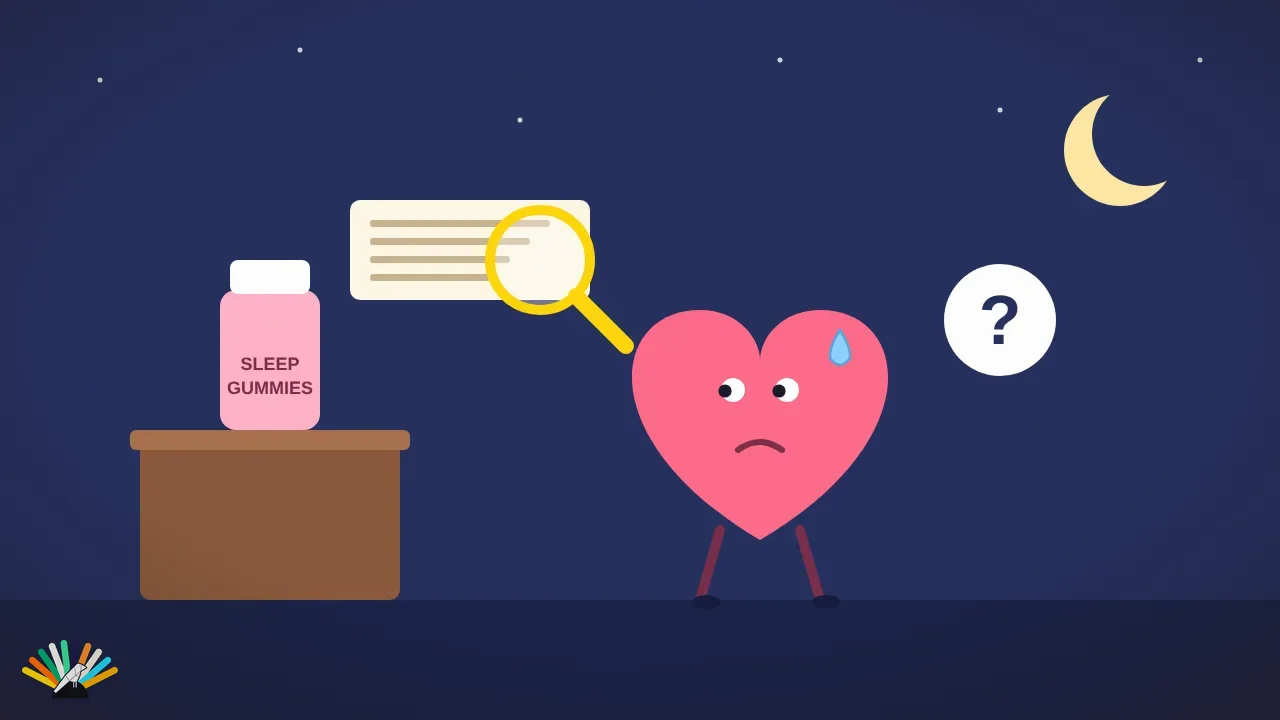
Melatonin feels like the gentlest thing in the bathroom cabinet. It's a hormone your own brain makes when it gets dark, and in many countries you can buy it as gummies next to the vitamins. So when a study linked long-term use to heart failure, a lot of people looked at their bedside table.
What melatonin does
Your body makes melatonin naturally, mostly at night. It tells your body clock it's time to sleep. Supplements add more on top, which is why people use them for jet lag or trouble falling asleep. In the US you can buy it without a prescription. In the UK you need one. That difference will matter in a minute.
The study
Researchers looked at the medical records of 130,828 adults diagnosed with insomnia, over five years. They compared people whose records showed at least a year of melatonin use with people whose records never mentioned it.
The results were striking. The melatonin group had about a 90% higher chance of being diagnosed with heart failure. Heart failure means the heart can't pump blood as well as it should. They were also nearly 3.5 times as likely to end up in hospital because of it, and almost twice as likely to die from any cause during the study.
The lead author, Dr. Ekenedilichukwu Nnadi, said: "Melatonin supplements are widely thought of as a safe and 'natural' option to support better sleep". His team's conclusion was that they "may not be as harmless as commonly assumed".
Now the small print
This is the important part, so read it slowly.
First, it was an observational study. It found a link, not proof. Dr. Nnadi said it himself: "our study cannot prove a direct cause-and-effect relationship". People who take melatonin for a year might simply be sicker, more stressed or sleep worse to begin with, and bad sleep itself is hard on the heart.
Second, the researchers didn't know how bad each person's insomnia was, or their history of mental health problems. Both could change the picture.
Third, the melatonin you buy at the shop often isn't in your medical records. Some people counted as "non-users" may have been taking it all along. Mixing US records, where it's sold freely, with UK records, where it needs a prescription, makes the groups messier.
Fourth, it was presented at the American Heart Association's big meeting but hadn't yet been through full peer review in a journal. That's when other experts check the work line by line.
A doctor's raised eyebrow
Another expert, Dr. Marie-Pierre St-Onge, pointed out something odd. She said she was "surprised that physicians would prescribe melatonin for insomnia", because it's "not indicated for the treatment of insomnia". In other words, it's meant for body-clock problems like jet lag, not as a nightly sleeping pill.
What it means for you
Don't throw out the bottle in a panic, and don't keep popping gummies on autopilot either. If you've taken melatonin most nights for months, tell your doctor, especially if you have heart problems or a family history of them. Ask whether it's the right tool for your kind of sleep trouble.
The boring fixes still work best for most people: same bedtime, dark room, phone out of the bedroom. Not as sweet as a gummy. But your heart won't argue with them.