

Every parent has done it. Bare feet, dark hallway, one tiny LEGO brick. Pain. Before you curse it, here's a small consolation: that brick is one of the most carefully made objects in your house.
It starts as grains
A LEGO brick begins life as little plastic granules, mostly a plastic called ABS. At the main factory in Billund, Denmark, about 60 tonnes of material go through the warehouse every 24 hours. A typical LEGO plant has around 14 silos, each holding 33 tonnes of granules. That's a lot of future foot injuries.
Melt, squeeze, cool
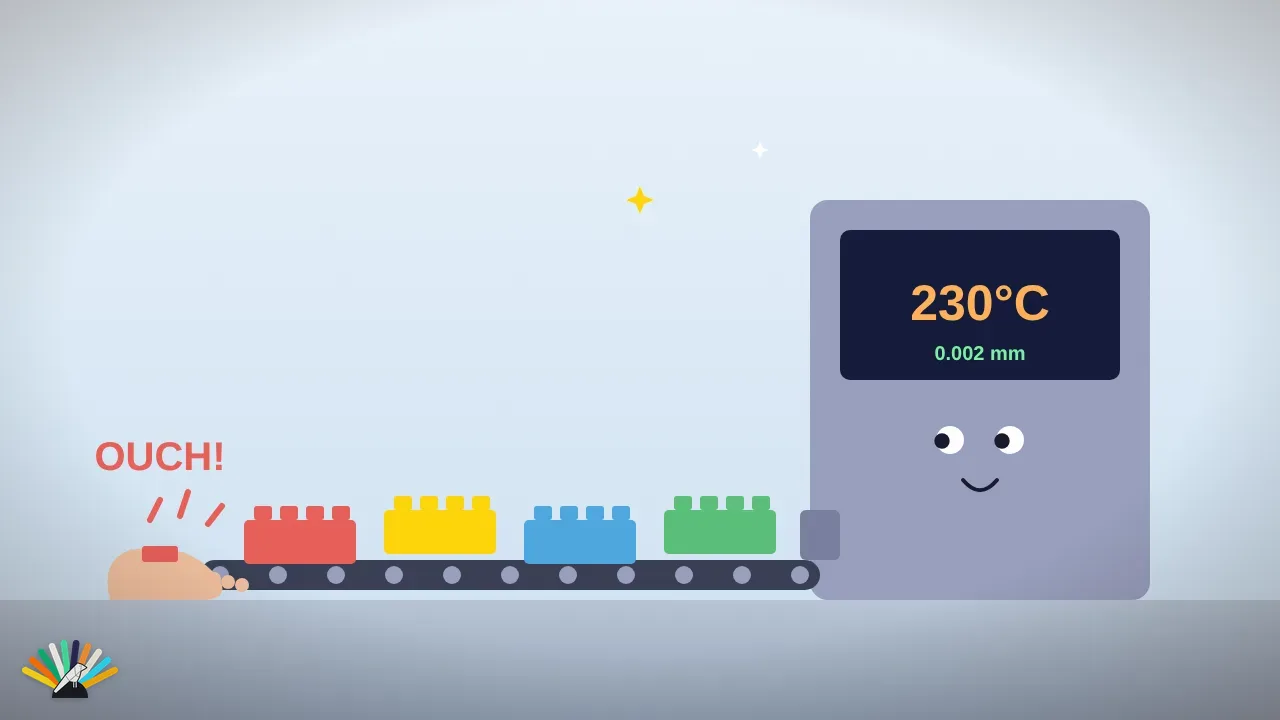
The granules are fed into injection moulding machines. These melt the plastic at up to about 230 °C (450 °F) and press it into steel moulds with between 25 and 150 tonnes of force. Then the piece cools for about seven seconds and pops out.
The moulds are the real stars. Their precision tolerance is as small as 0.002 millimetres. That's why a brick made today clicks perfectly onto one your dad bought in the 1970s. A human hair is about 35 times thicker than that tolerance. Basically, LEGO is fussier than your mother-in-law.
The numbers are silly
A 2016 look inside the factory counted about 36,000 pieces a minute, or roughly 2.16 million an hour. Over a year, that worked out at around 36 billion pieces. Those numbers are a few years old, but the point stands: whatever you just stepped on had billions of siblings.
Hundreds of thousands of pieces leave the Billund factory every single day: bricks, minifigure hair, dragon wings, tyres. LEGO has more than 20,000 employees worldwide, and over a quarter of them work in Billund.
Who does the work?
Mostly machines, because the job involves very high heat and very big equipment. In Billund, eight robots moved around 600 bins of elements an hour, and four storage halls had no humans inside at all, just "cranebots" stacking and fetching boxes. The AFP described robots gliding around a giant hall in a kind of coordinated dance.
Painting faces and details is the most expensive step, and that's done by machines with extreme precision too. At the end, optical sensors count the pieces and very precise scales weigh every box. If the weight is off by a few micrograms, an alarm goes off and an operator fixes it. That's why you almost never find a piece missing. When you do, it's under the sofa.
Nothing is wasted
The bits of plastic that connect pieces in the mould, called sprues and runners, get recycled. So do the little plugs pushed out of the machine's nozzle, which fans call "LEGO cigars". When a mould doesn't fill properly, you get a "short shot", a half-formed brick. Most are recycled, but collectors hunt for the few that escape.
How it all began
LEGO's first plastic moulding machine arrived in Billund in 1947 and was set up in a hut next to the old woodworking shop. Before plastic, the company made wooden toys. Its founder, Ole Kirk Kristiansen, once reused leftover yo-yos as wheels for toy wagons. The company historian, Signe Wiese, said he "was really fascinated with the technology and the machinery and the material itself".
Today LEGO is the world's biggest toymaker. Not bad for a carpenter with spare yo-yos.
So the next time you step on a brick at midnight, try to think of the robots, the 230 degrees and the 0.002 millimetres. It won't hurt less. But at least you'll know it was made perfectly.