
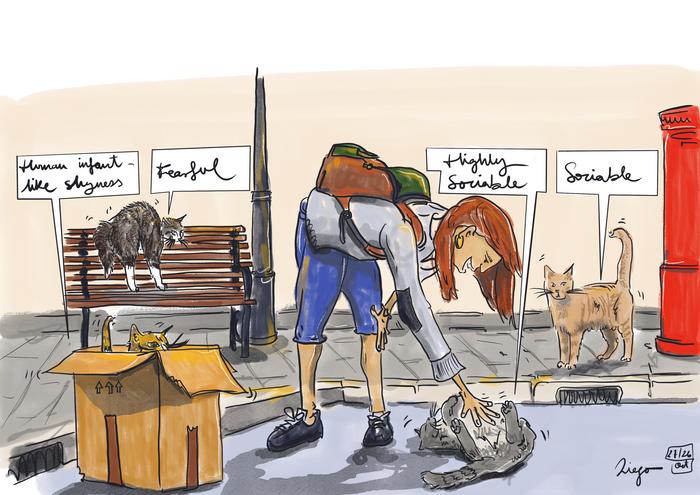
Cats have a reputation. Aloof, independent, a little bit judgmental. But two studies published this month say the real picture is a lot more human than that. One looks at how cats feel about strangers. The other looks at how they talk to the people they already own. Put them together and you get a surprisingly clear portrait of the animal on your sofa.
Part one: the shy cat is not just a scared cat
Researchers at Kyoto University in Japan, led by Madoka Hattori, wanted to know whether cats can be shy in the same way small children are. Not simply afraid, but curious and nervous at the same time. The kind of toddler who hides behind a parent's leg and still peeks out to see who just walked in.
To test it, the team took a questionnaire used to measure personality in human infants and adapted it for cats. Owners of 310 cats filled it in. The study was published on November 4, 2026 in the journal PLOS One.
The results sorted the cats into four personality types: highly sociable, sociable, fearful and shy. The shy group is the interesting one. These cats scored high on fear, but also high on wanting to approach. In other words, they are scared of the stranger and want to meet them anyway. That mix is exactly what psychologists call shyness in babies.
This human-like shyness showed up more often in male cats and in cats that were born as strays. "Our findings suggest that shyness in cats is more complex than simply being afraid of humans," the authors wrote. Hattori added that she hopes the work makes people rethink stereotypes like "dogs are friendly" and "cats are aloof."
Part two: the meow is a message, and it is for you
The second study comes from researchers in Brazil and was published in the journal Animal Behaviour. The setup was simple and a little bit mean. Each of 38 pet cats sat in front of a closed plastic box with its favorite food inside. It could smell the snack but could not open the box.
The scientists watched each cat for one minute with its human sitting nearby and paying attention, and again with the cat alone. The difference was striking. With a person in the room, the cats meowed far more, and they kept looking back and forth between the human and the box. Alone, they mostly went quiet.
The researchers say this fits the idea that meowing plays a "communicative role" between cats and people. Adult cats rarely meow at each other. The meow is, in large part, a sound they use on us.
Why the two studies belong together
Read side by side, these studies tell one story. Cats are not cold little machines. Some of them are nervous but curious, like a shy child at a birthday party. And when they want something, they know exactly who can help, and they look at that person and ask.
Both studies have limits. The shyness research relies on what owners report, and the meowing study is small. Both teams say more work is needed.
Our take
If your cat hides when guests arrive but keeps peeking from under the bed, it may not be rude. It may just be shy. And the next time it stares at you and meows next to an empty bowl, take it as a compliment. Out of everyone in the house, it chose you to complain to.
Source: PLOS One, Kyoto University via EurekAlert, Animal Behaviour, Gizmodo, Euronews
Photo: Diego Perez-Lopez, PLOS, CC BY 4.0