
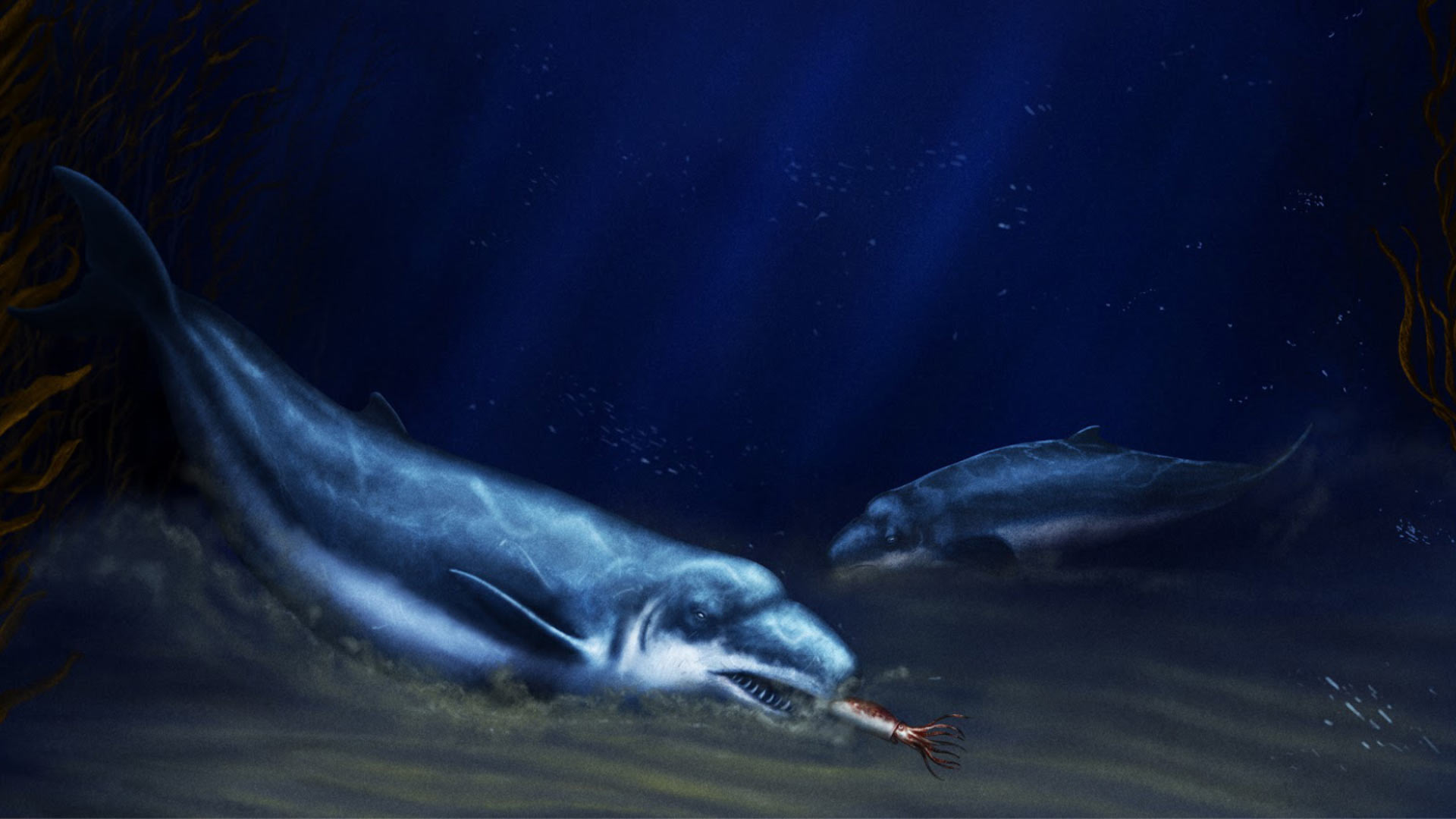
When a young Peruvian scientist first looked at an old fossil skull sitting in a museum drawer in Lima, he thought something had gone wrong with it. The bones looked twisted, as if the skull had been crushed by rock over millions of years. It had not. The crooked face was real, and it belonged to one of the strangest whales that ever lived.
Meet the "extravagant" whale
The animal has been named Scaphokogia huachafo. "Huachafo" is a word from Peruvian Spanish that means extravagant, bizarre or a bit tacky, which suits it well. It was a small relative of today's pygmy sperm whales, about 2.7 metres (9 feet) long, and it swam off the coast of what is now southern Peru between 6.3 and 5.6 million years ago, in the Late Miocene.
The fossil was dug out of the Pisco Formation, one of the richest fossil sites for marine animals in the world, back in the 1990s. Then it sat in the collections of the Museum of Natural History in Lima for years. In 2015, palaeontologist Aldo Benites-Palomino, then a student, came across it while working on his Bachelor's thesis.
"The skull looks completely crooked," he said. At first he wondered if the shape came from damage. But the bones showed no fractures and no signs of disease, and the joins between them were fully closed. "This was genuine biology, not a result of poor preservation," he said.
A record-breaking twist
Many toothed whales have slightly lopsided skulls. It is linked to the way they make sounds for echolocation. But Scaphokogia huachafo took it to an extreme. Its snout was bent downward by 31 degrees compared with the rest of the skull. Both of its bony nostrils were pushed entirely to the left side of the head, and the left one was much bigger than the right.
The research team compared 3D models of skulls from 31 whale species. Scaphokogia came out as the most asymmetric group in the whole sample. According to the University of Zurich, it is the most extreme facial asymmetry known in any whale, and possibly in any mammal.
Built to hunt on the bottom
Why would a whale grow a face like that? The scientists think the answer is food. A second fossil, which preserved the first bone of the neck, suggests the animal could bend its head downward by as much as 55 degrees. Its snout was a heavy tube of dense bone that worked like ballast, pulling the front of the body down toward the seabed.
"The entire cranio-cervical complex is modified to point the snout directly toward the bottom," said co-author Gabriel Aguirre-Fernández, a palaeontologist at the University of Zurich.
The whale probably cruised slowly over the floor of shallow coastal waters, scanning soft sand and mud with sound to find prey. The researchers at FAU Erlangen-Nürnberg, where Benites-Palomino now works, think it most likely went after octopuses and squid, perhaps sucking them up from the bottom. It had no whiskers and no special eyes for the job, so its lopsided sonar was probably its main tool.
The study was published in the journal Communications Biology.

Why it matters
Today's pygmy and dwarf sperm whales are shy, rarely seen animals. Fossils like this one show that their family was once far more varied and experimental, with species that tried very different ways of living. Scaphokogia huachafo is a reminder that evolution does not aim for neat or pretty. It aims for whatever works.
Our take
There is something wonderful about a fossil waiting in a museum drawer for decades until the right person looks at it with fresh eyes. What looked like a broken skull turned out to be a perfectly designed tool for hunting on the seafloor. Sometimes the strangest-looking animals are the most specialised, and this crooked little whale clearly knew exactly what it was doing.
Source: University of Zurich, FAU Erlangen-Nürnberg, Communications Biology, Sci.News
Photo: Jaime Bran Sarmiento / University of Zurich