
Space news usually moves slowly. Missions take years, results take more years. But this November, two European Space Agency spacecraft sent home surprises within weeks of each other. One answered a question NASA asked with a very loud bang in 2022. The other found something it was never supposed to look for.
Surprise one: the scar on Dimorphos
On September 26, 2022, NASA's DART spacecraft flew into a small asteroid called Dimorphos at about 6.1 kilometers per second. On purpose. The goal was to test whether we could nudge a dangerous asteroid off course one day.
It worked better than expected. Dimorphos orbits a bigger asteroid, Didymos, and the crash shortened that orbit by about 33 minutes. Scientists had hoped for much less.
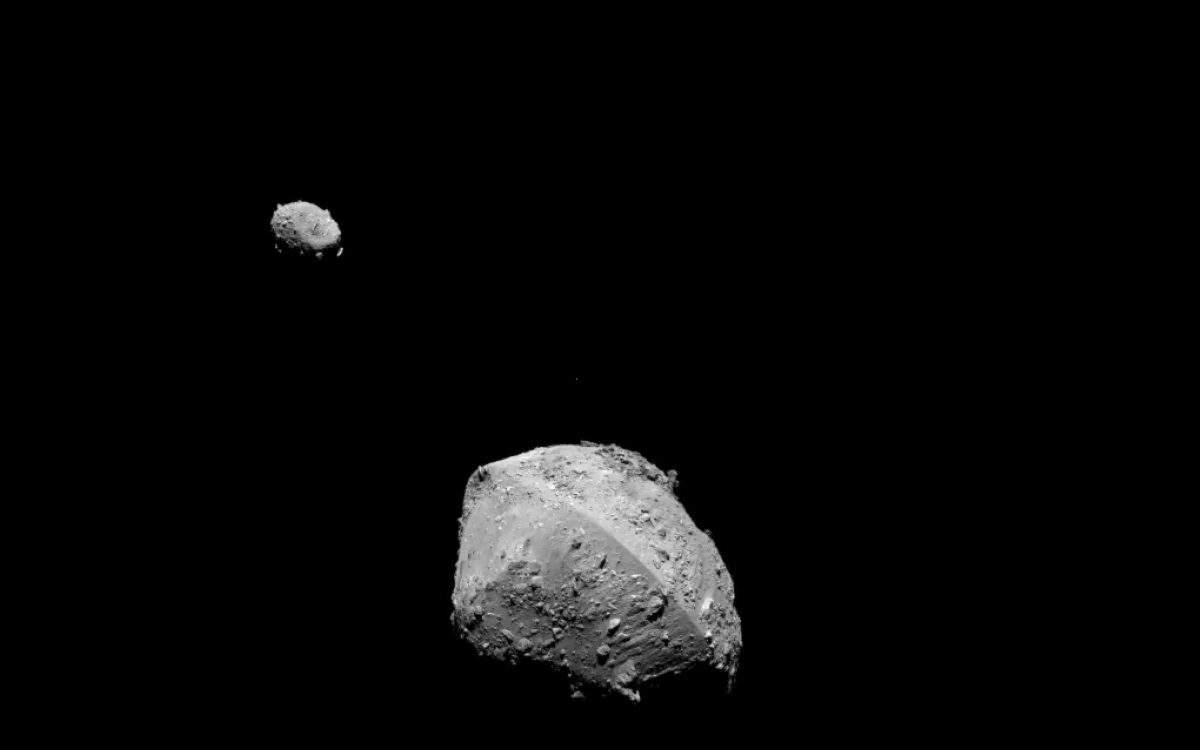
But nobody had seen the damage up close. Did DART leave a crater, or did it squash the whole asteroid into a new shape? That is the job of ESA's Hera spacecraft, which reached the pair this autumn.
On November 25, ESA released Hera's first detailed images of Dimorphos. They show a huge crater across the face that DART hit. Hera mission manager Ian Carnelli said the team was not sure if they would see a crater or a reshaped asteroid, and added: "I think we see a bit of both."
Hera's principal investigator, Patrick Michel, described the first close look at Didymos simply: "The first thing we said was wow!"
Surprise two: the dark matter telescope that found a comet
ESA's Euclid telescope has a serious job. It maps billions of galaxies to understand dark matter and dark energy. Comets are not on the to-do list.
Then a PhD student at the University of Helsinki, Mikko Pöntinen, wrote software to spot moving objects in Euclid's images. In pictures taken in September 2026, it flagged a faint streak. "I was excited to see my software flag a 'streak' smeared across several images," he said.
The streak turned out to be a comet never seen before, now officially named C/2026 S1 (Euclid). The Minor Planet Center confirmed it on October 8. ESA says it was about 1.3 billion kilometers from Earth.
Why these two stories belong together
Both missions show how much of science is about looking closely and being ready for the unexpected. Hera went to check one crash and found a messier, more chaotic world than models predicted. Euclid was staring at the deep universe and caught a visitor from our own solar system.
Both are also about protecting Earth. DART and Hera test how to deflect an asteroid. Finding unknown comets and rocks early is the first step in any planetary defense plan.
Our take
We hit an asteroid, and it is still wobbling from the punch. A dark matter telescope spotted a comet as a side quest. Space keeps reminding us that the most interesting results are often the ones nobody planned. Hera's two small CubeSats are due to take an even closer look early next year, so the asteroid story is far from finished.
Source: ESA, NASA, ScienceDaily, ZME Science
Photo: ESA