

For more than three decades, Jensen Huang and his leather jacket were Nvidia. Then, in one month, the most watched boss in tech went from "untouchable" to "gone" and back to "CEO" again. If you blinked, you missed a whole season of drama. Here is what happened, step by step, with a clear line between what is confirmed and what is only reported.
October 29: the first report
The New York Times reported that U.S. intelligence officials had concerns about Alice Huang, a Chinese businesswoman linked to the Singapore-based company Megaspeed, who had grown close to the Nvidia chief. The two are not related. Some officials in the Trump administration reportedly believed she was gathering information for Beijing. China's foreign ministry called the spy claim "unsubstantiated" and "smears against China." No agency has publicly established that she knowingly acted as a spy.
Early November: Huang admits he was unfaithful
In a memo to staff, Huang admitted he had been unfaithful to his wife and took "full responsibility." He did not name anyone. "My actions hurt her and our children. There is no excuse for what I did," he wrote. Nvidia's board opened an independent investigation and said it still had confidence in him.
November 11: a second report, and the board meets
The New York Times then reported a second alleged relationship, this time with a senior Nvidia executive. Nvidia did not comment, and the claim has not been independently verified. The same day, The Wall Street Journal reported that the board was preparing to push Huang out. Nvidia shares dropped sharply in after-hours trading.
November 12: he steps down
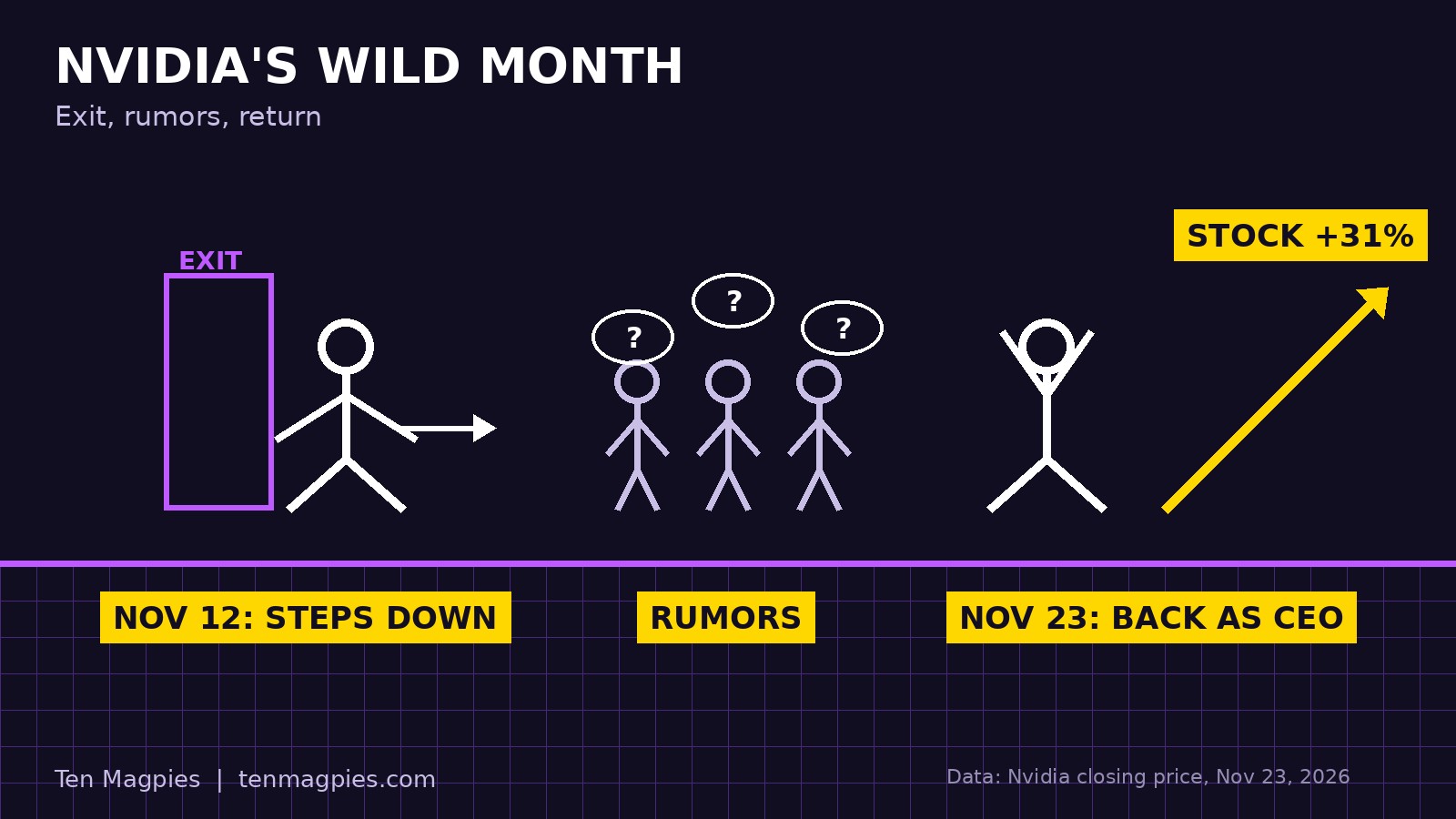
Huang resigned on November 12. Chief financial officer Colette Kress was named to run the company. At the quarterly results on November 17, chairman Harvey Jones said the board did not intend to bring Huang back.
The rumor mill: "at least four"
This is where the gossip took over. Reuters reported claims of a third relationship, and The Wall Street Journal later reported that Huang had privately told the board about at least two more affairs, which would bring the total to at least four. None of these extra reports has been confirmed by Huang or Nvidia, so for now they stay in the rumor column.
Markets panic, then Washington steps in
Investors did not like a Nvidia without its founder. The stock dropped more than 20% after the earnings report. Then politics entered the room. President Trump said rehiring Huang would be "the best thing for the company, and also, for the USA." Later he told CNBC: "I made the deal."
November 23: the comeback
On Monday, November 23, the board unanimously reinstated Huang as president and CEO. It said it was "confident" he poses no national security risk, after "input from senior levels of the United States government." Huang said he takes the job back "with the greatest humility." To employees he was blunter: "I've made some very terrible mistakes."
Wall Street cheered. Nvidia closed up about 31% that day, and the Nasdaq rose about 6.5%. Not bad for a Monday, even by Nvidia standards.
What happens next
The story is not over. The independent investigation continues, Nvidia is creating a national security committee and a chief compliance officer, and Huang is expected to face questions in Congress in early December. The U.S. also added Megaspeed to its trade blacklist on the day he returned.
Our take
This is a strange lesson in modern business: a CEO can lose his job over his private life and get it back weeks later because markets and governments decided the company needs him. The numbers say investors agree. Whether the trust inside Nvidia comes back as fast as the share price is a different question, and that one will take longer than a month.
Source: The New York Times, The Wall Street Journal, Reuters, TIME, Al Jazeera, Yahoo Finance, ABC News
Photo: Peter Dasilva, © European Union 2024, CC BY 4.0