
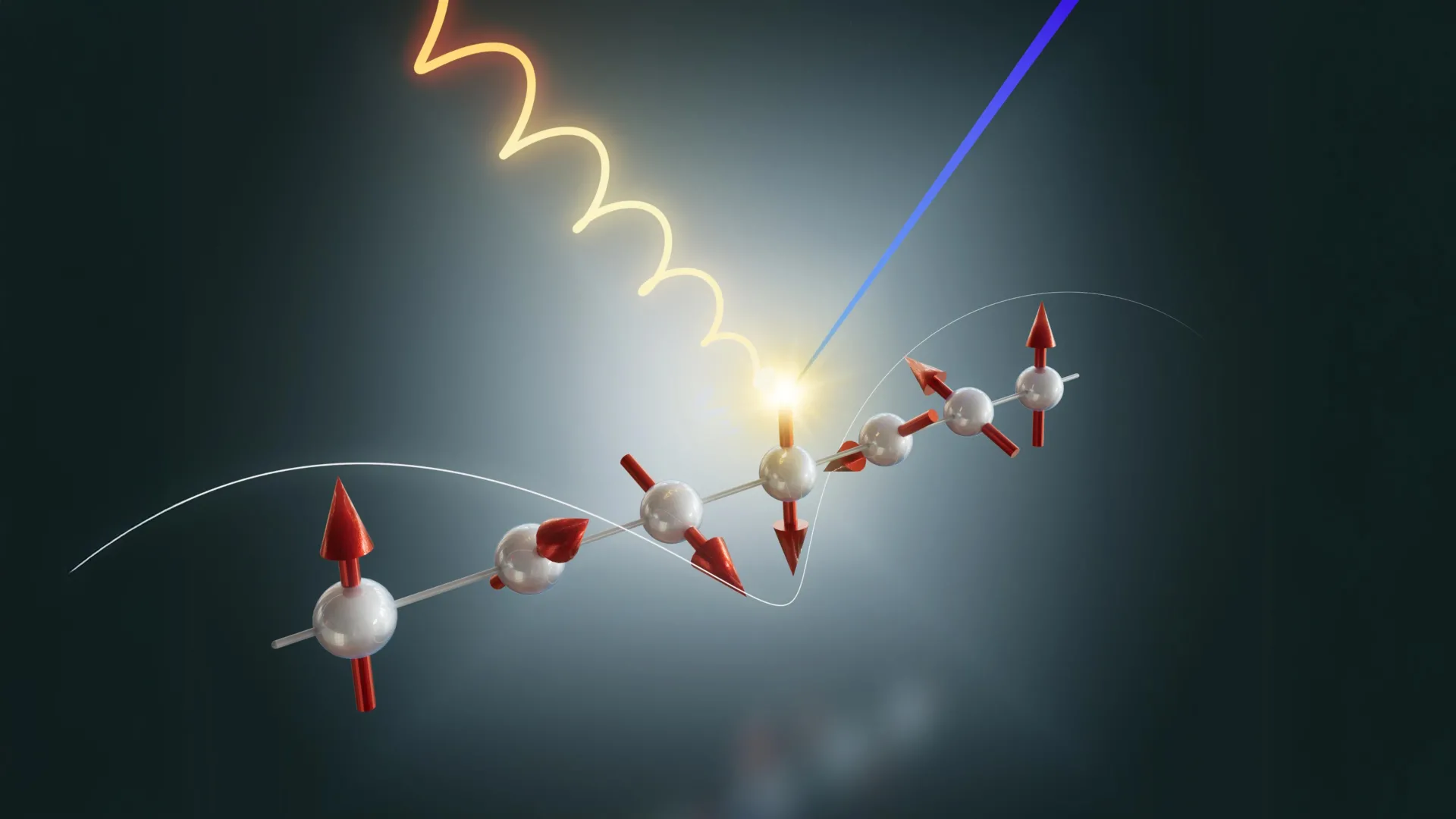
Most of us know two kinds of magnets: the ones that stick to the fridge, and the ones that do not stick at all. Physicists have long known the real picture is more complicated. Now a team led by the Max Planck Institute for Chemical Physics of Solids in Dresden, Germany, says it has found the first clear evidence of a new type of magnetism, called p-wave magnetism, in a simple metal.
The metal
The material is europium silicide, or EuSi, made from the elements europium and silicon. When it is cooled to between about 33 and 62 degrees above absolute zero, the tiny magnetic moments of its europium atoms line up in a spiral pattern.
Because the spiral turns in a circle, the magnetic effects cancel out. The metal as a whole has no overall magnetism. It would not stick to your fridge.
The surprise
Yet when the team looked at the electrons moving through the metal, they found something unexpected. The electrons' spins, a quantum property that makes them behave like tiny magnets, were arranged in a special pattern that flips direction depending on how the electrons move. This is the signature of p-wave magnetism.
"We were surprised by the exceptionally large effect of magnetism on the electrons," said first author Erjian Cheng, a group leader at the institute. The energy differences caused by the magnetism were more than 100 milli-electronvolts, which is large for this kind of effect.
The researchers also found that regions in the crystal, each about 10 micrometres across, twist in opposite directions, like left and right hands. These regions respond differently to circularly polarised light.
The study was published in the journal Nature. It involved 38 researchers from 19 institutions, and the crystals were grown about three years before the results came out. To see the effect, the team used several advanced methods, including neutron scattering and a technique that knocks electrons out of the metal with light to measure their energy and spin.

Why it matters
Today's electronics move information using the charge of electrons. A field called spintronics wants to use electron spin as well, which could make devices faster and much more energy-efficient. Materials with no overall magnetism but strongly spin-polarised electrons are especially attractive, because they do not create stray magnetic fields that disturb nearby parts.
"This demonstrates how the discovery of new materials can reveal entirely new electronic phenomena," said institute director Professor Claudia Felser.
The researchers are careful to say that some predicted effects, such as spin-polarised currents without an outside magnetic field, have not yet been shown in EuSi. That is the next step.
Our take
This is not a gadget you will buy next year. It is the kind of basic discovery that quietly shapes the technology of the 2040s. What makes it exciting is how ordinary the ingredients are: a simple metal, grown years ago, that turned out to be hiding a new kind of magnetism all along. Sometimes the future is already sitting in a lab drawer, waiting for someone to look closely.
Source: Max Planck Institute for Chemical Physics of Solids, Nature, EurekAlert, ScienceDaily
Photo: MPI CPfS / C. Pouss