
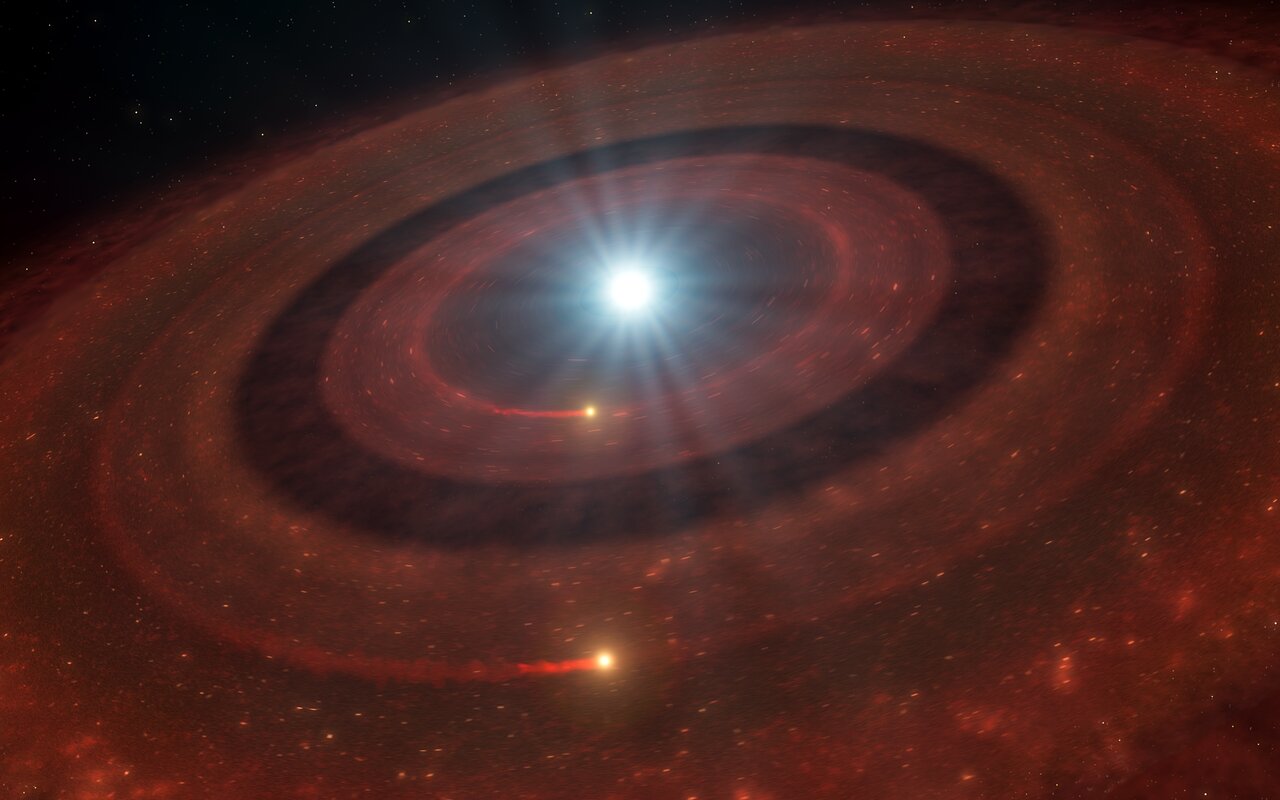
Just in time for the end of Halloween season, astronomers have found a cosmic graveyard where something is still walking around. Or at least orbiting.
Two rings, one big gap
The dead star is J1328-1450, a white dwarf about 1,600 light-years away. That's the burnt-out core left when a star like the Sun runs out of fuel. As such stars die, they swell, throw off their outer layers and destroy nearby planets. The surviving rocks can break apart and form a disc of rubble.
Every known debris disc around a white dwarf has looked like a single, flat ring. This one has two, with a clear gap between them. The team spotted it with the X-Shooter instrument on ESO's Very Large Telescope in Chile, and published the result in Nature Astronomy.
Meet the survivors
The likely explanation is two planet-like bodies that made it through the star's death on separate orbits. The inner one is about the size of a typical asteroid, a few kilometres across. The outer one could be as big as Pluto or even our Moon. “Zombie planets” is the press's nickname, by the way. The scientists prefer “planetesimals”, which is less fun on a poster.
The rings hold calcium, oxygen, magnesium and iron, similar to rocky material in our Solar System, and they differ from each other. They may come from two different planets, or from different parts of one, such as crust and core.
Should we panic?
Not this week. The Sun will become a white dwarf too, in a process that may destroy Earth, but Space.com puts its red giant phase about 5 billion years away. You still have time to finish your to-do list. Possibly.